
Pakistan Solar Market Update — July 2026 — Prices, Trends and News
The Pakistani solar market continues its rapid expansion in 2026. Panel prices remain near historic lows, government support continues, and adoption is accelerating from residential to commercial and industrial sectors. Here is a comprehensive market update for July 2026.
Solar Panel Prices — July 2026
Note on prices: The figures below are a snapshot from around the time this article was published. Solar rates in Pakistan change frequently — for today’s live prices, see our daily solar panel rates.
| Panel Type | Wattage | Price Range (per panel) | Price per Watt |
|---|---|---|---|
| Mono PERC (Tier-1) | 550W | Rs. 10,000–12,500 | Rs. 18–23 |
| TOPCon N-type (Tier-1) | 580–600W | Rs. 11,000–14,000 | Rs. 19–24 |
| HJT (Premium) | 570–600W | Rs. 16,000–22,000 | Rs. 28–37 |
| Local / Tier-2 PERC | 540W | Rs. 7,500–9,500 | Rs. 14–18 |
Inverter Prices — July 2026
| Brand / Model | Type | Capacity | Price |
|---|---|---|---|
| Growatt MIN 6000TL-XH | Hybrid | 6kW | Rs. 95,000–115,000 |
| Deye SUN-6K-SG04LP1 | Hybrid | 6kW | Rs. 90,000–110,000 |
| Sungrow SH6.0RS | Hybrid | 6kW | Rs. 105,000–130,000 |
| Knox 6kW Hybrid | Hybrid | 6kW | Rs. 75,000–95,000 |
| Huawei SUN2000-5KTL | String | 5kW | Rs. 80,000–100,000 |
Key Market Developments — July 2026
- TOPCon now mainstream: TOPCon N-type panels have largely replaced Mono PERC as the standard for new installations — better efficiency and temperature performance at near-equivalent pricing
- Battery adoption accelerating: Lithium battery attachment rate with new solar installations now exceeds 60% in urban Pakistan — up from ~30% in 2023
- Net metering backlog: LESCO, IESCO, and HESCO continue to have 6–16 week backlogs for net metering approvals — plan accordingly
- PM Solar Scheme continuation: Federal government has announced continuation of solar subsidy programs for 2026–2027 with expanded eligibility
- Industrial solar growing: Textile sector installations > 500kW have increased 340% year-on-year as industrial tariffs remain elevated
- Installers’ capacity under pressure: Summer 2026 is again seeing 4–8 week installation wait times from reputable companies — book early
Complete System Prices — July 2026
| System | Type | Components | Installed Price |
|---|---|---|---|
| 3kW | Hybrid, no battery | 6 × 550W + hybrid inverter | Rs. 380,000–480,000 |
| 5kW | Hybrid, no battery | 10 × 550W + hybrid inverter | Rs. 600,000–750,000 |
| 5kW | Hybrid + 5kWh lithium | 10 × 550W + hybrid + battery | Rs. 800,000–1,000,000 |
| 6kW | Hybrid, no battery | 12 × 550W + hybrid inverter | Rs. 700,000–900,000 |
| 10kW | Hybrid, no battery | 20 × 550W + hybrid inverter | Rs. 1,100,000–1,400,000 |
| 10kW | Hybrid + 10kWh lithium | 20 × 550W + hybrid + 2 batteries | Rs. 1,500,000–1,900,000 |
📊 Compare prices across all system sizes
Sources & references
Tariff, net-metering, and policy details on this page draw on the following official sources. Rates change often, so confirm current figures with the relevant authority or a licensed installer before you decide.
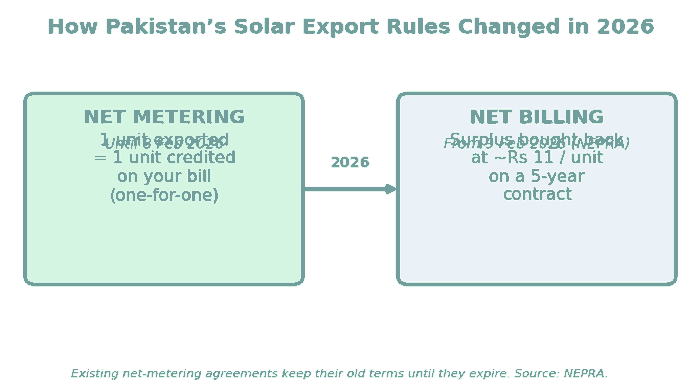
- NEPRA — National Electric Power Regulatory Authority: electricity tariffs and the 2026 shift from net metering to net billing.
- AEDB — Alternative Energy Development Board: solar policy, installer standards, and net-metering guidance.
- Your local distribution company (DISCO) — for example LESCO, K-Electric, IESCO, MEPCO, PESCO or QESCO — for area-specific tariffs and the net-metering application process.