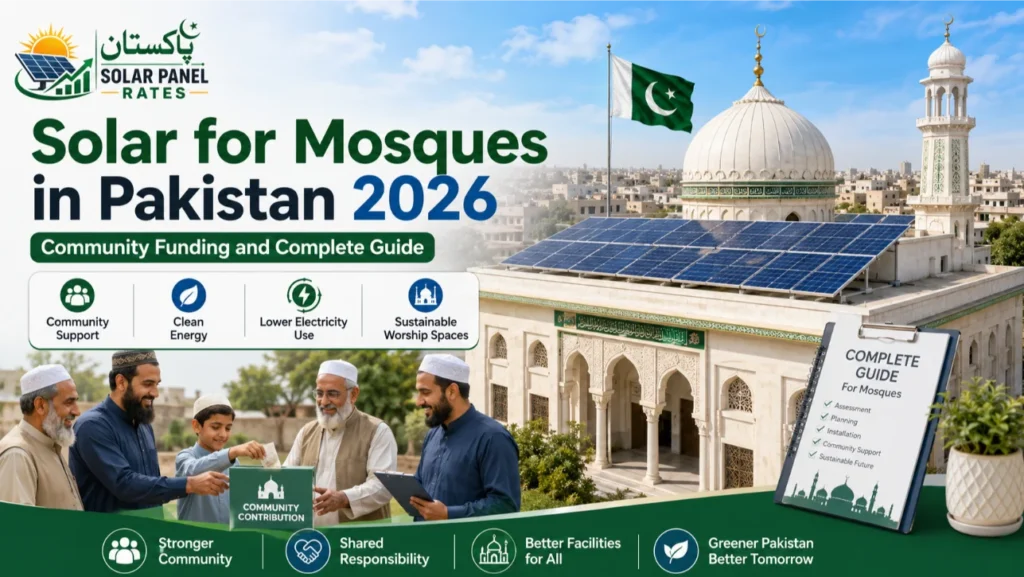
Solar for Mosques in Pakistan 2026 — Community Funding and Complete Guide
Why Solar Is Perfect for Mosques
- Prayer times align with solar generation: Four of the five daily prayers (Fajr excluded) fall during daylight hours — peak solar generation matches peak mosque usage
- Large flat rooftops: Most mosques have substantial flat dome rooftops and surrounding flat areas suitable for panel installation
- Community ownership: Mosques have established jamat and donation systems — solar can be funded through sadaqah, zakat, or specific solar fundraising drives
- Reduce financial burden on mosque: Electricity bills of Rs. 15,000–60,000/month can be dramatically reduced, freeing funds for other community purposes
- Tarawih electricity during Ramadan: Evening Tarawih prayers create significant electricity demand — a battery system ensures smooth operation throughout
Typical Mosque Load and System Sizing
| Mosque Size | Typical Monthly Bill | Recommended System | Approx. Cost |
|---|---|---|---|
| Small neighbourhood mosque | Rs. 8,000–20,000 | 3–5 kW hybrid | Rs. 500,000–750,000 |
| Medium jamia masjid | Rs. 20,000–45,000 | 6–10 kW hybrid | Rs. 800,000–1,300,000 |
| Large central mosque (AC) | Rs. 50,000–120,000 | 15–25 kW 3-phase | Rs. 2,000,000–3,500,000 |
Funding Options for Mosque Solar
Community Fundraising (Most Common)
Many mosques have successfully funded solar installations through community donations. A WhatsApp campaign among regular congregants and the wider diaspora (overseas Pakistanis contribute to mosque solar projects via remittances) can raise Rs. 500,000–1,500,000 within weeks for well-known mosques.
Waqf Board Support
Pakistan’s Auqaf Department manages hundreds of mosques in each province. Applications for solar installation can be submitted to provincial Auqaf departments — some provinces have allocated funds for solar installation at Auqaf-managed mosques.
Zakat and Sadaqah
Many scholars have issued rulings permitting use of sadaqah (voluntary charity) for mosque infrastructure improvements including solar. Zakat applications are more nuanced — consult with local ulema on the specific ruling in your context.
CSR Partnerships
Solar companies increasingly offer CSR programs where they co-fund mosque solar installations in exchange for visibility. Some companies have installed 100+ mosque solar systems as community outreach programs. Contact solar companies directly about CSR mosque solar partnerships.
Frequently Asked Questions
☀️ Power your mosque sustainably
Sources & references
Tariff, net-metering, and policy details on this page draw on the following official sources. Rates change often, so confirm current figures with the relevant authority or a licensed installer before you decide.
- NEPRA — National Electric Power Regulatory Authority: electricity tariffs and the 2026 shift from net metering to net billing.
- AEDB — Alternative Energy Development Board: solar policy, installer standards, and net-metering guidance.
- Your local distribution company (DISCO) — for example LESCO, K-Electric, IESCO, MEPCO, PESCO or QESCO — for area-specific tariffs and the net-metering application process.