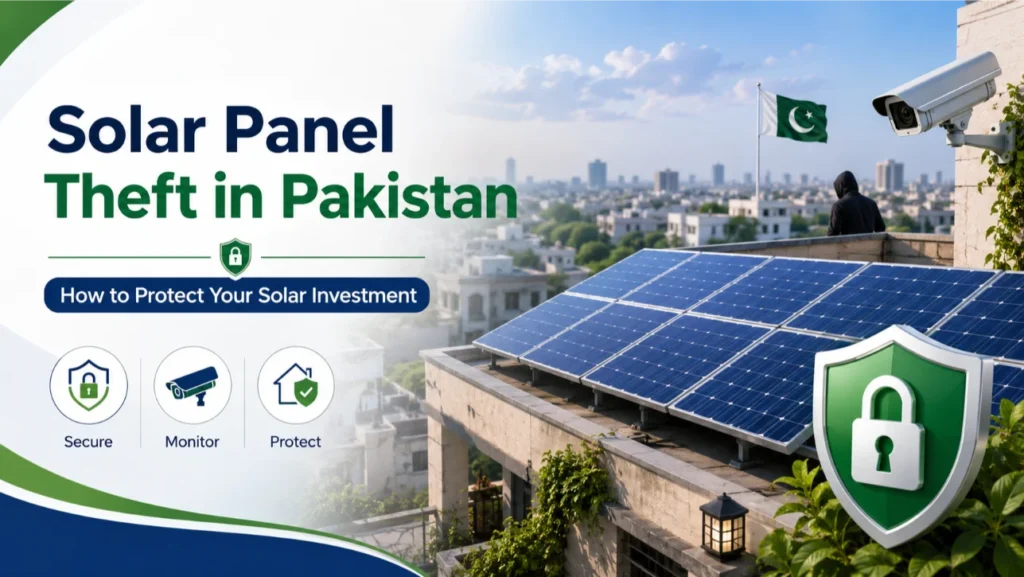
Solar Panel Theft in Pakistan — How to Protect Your System
As solar systems have become more prevalent across Pakistan, solar panel theft has emerged as a growing problem — particularly in rural areas and on unoccupied properties. A single stolen 550W panel costs Rs. 12,000–18,000 to replace, and a complete 10-panel system represents Rs. 120,000–180,000 of exposed hardware on your roof. This guide covers practical, affordable theft prevention strategies for Pakistani solar owners.
How Common Is Solar Panel Theft in Pakistan?
Solar theft incidents have been reported across all four provinces, with the highest concentration in:
- Rural and peri-urban Punjab (farms, empty plots, tube well setups)
- Balochistan and KPK rural areas (panels on unoccupied homes)
- Agricultural land with solar tube well systems
- Commercial and industrial rooftops in industrial estates
- Newly installed systems on properties under construction
📋 Context: Urban residential rooftop installations (behind boundary walls in populated neighborhoods) are significantly lower-risk than rural or isolated installations. Most theft targets easily accessible, unmonitored systems.
Anti-Theft Protection Methods — Ranked by Effectiveness
| Method | Cost | Effectiveness | Best For |
|---|---|---|---|
| Anti-theft mounting bolts (one-way screws) | Rs. 500–1,500/panel | ⭐⭐⭐⭐ | All installations |
| CCTV cameras on roof | Rs. 8,000–25,000 (system) | ⭐⭐⭐⭐ | Urban homes, commercial |
| Solar monitoring with alert (inverter app) | Free (built into inverter) | ⭐⭐⭐ | All grid-connected systems |
| Steel cable locking system | Rs. 2,000–5,000 | ⭐⭐⭐ | Rural/isolated locations |
| Panel marking (laser etching, UV marking) | Rs. 200–500/panel | ⭐⭐⭐ | All installations |
| Boundary wall + barbed wire | Existing or Rs. 5,000–15,000 | ⭐⭐⭐ | Rural properties |
| Security guard (rural commercial) | Rs. 20,000–35,000/month | ⭐⭐⭐⭐⭐ | Large commercial/industrial |
| Neighborhood watch/chowkidar | Shared community cost | ⭐⭐⭐ | Rural villages |
Step-by-Step: How to Protect Your Solar Installation
- Use anti-theft mounting bolts during installation — Ask your installer to use tamper-resistant or one-way bolts on all panel mounting points. This is the single most cost-effective theft deterrent — impossible to remove without specialized tools.
- Mark every panel with permanent identification — Engrave your CNIC number or property address on each panel frame using a grinder or laser. UV-pen marking on glass surface is also effective. Marked panels are harder to sell and easier to recover.
- Install inverter monitoring alerts — Most modern inverters (Growatt, GoodWe, Deye) have mobile apps that alert you if production drops unexpectedly. A sudden 0W reading mid-day can indicate panel removal.
- Add CCTV with night vision on roof — A 2–4 camera CCTV system covering your roof costs Rs. 15,000–30,000 installed. This deters theft and provides evidence for police reports and insurance claims.
- Register your system with serial numbers — Keep a record of all panel and inverter serial numbers with photographs. This is essential for police reports and recovery.
- Inform local police station — Register your solar installation at your local thana. Many thanas in high-theft areas have started maintaining solar installation registers to help with recovery investigations.
What to Do If Your Solar Panels Are Stolen
- File an FIR immediately at your local police station — include panel serial numbers and photographs
- Contact your solar installer — they can help identify if stolen panels appear at local second-hand markets
- Alert nearby solar dealers — stolen panels often surface at second-hand dealers within days
- Check local OLX and Facebook Marketplace listings for your panel models
- Contact your inverter manufacturer’s customer service — they can flag your system serial number
- File an insurance claim if your property insurance covers equipment theft
⚠️ Insurance note: Most standard Pakistani home insurance policies do NOT automatically cover solar panel theft. Ask your insurer specifically about adding solar equipment to your policy. Some insurers now offer solar-specific add-on coverage — typically Rs. 3,000–8,000/year for a 6kW system.
Frequently Asked Questions
❓ Is solar panel theft common in cities like Lahore and Karachi?
Urban rooftop theft is relatively uncommon in dense residential areas — the difficulty of accessing rooftops in gated areas plus neighbor visibility makes it high-risk for thieves. The main urban risk is commercial and industrial rooftops in industrial estates where security is less consistent. Rural and peri-urban areas carry significantly higher risk.
❓ Can stolen solar panels be traced?
Yes, if properly marked. Each solar panel has a unique serial number engraved on its frame. If you’ve recorded these numbers, police and dealers can identify your panels. Inverters are even more traceable — most have WiFi-registered serial numbers linked to your account with the manufacturer.
❓ Do anti-theft bolts work for solar panels?
Yes — tamper-resistant or one-way security bolts are highly effective. They require specialized extraction tools that most opportunistic thieves don’t carry. Combined with CCTV, anti-theft bolts reduce theft risk by over 90% according to installer experience. Always request them during installation — they add minimal cost (Rs. 500–1,500 per panel).
❓ Should I insure my solar panels in Pakistan?
Yes — especially if your system costs Rs. 500,000 or more. Ask your home insurer to include solar equipment under your existing policy (some allow this as an add-on) or get a dedicated equipment insurance policy. For commercial and farm systems, equipment insurance is strongly recommended.
🔒 Protect your solar investment
Check the latest solar system costs and plan a properly secured installation.
Today’s panel prices → | Installation cost guide → | All inverter brands →
Sources & references
Tariff, net-metering, and policy details on this page draw on the following official sources. Rates change often, so confirm current figures with the relevant authority or a licensed installer before you decide.
- NEPRA — National Electric Power Regulatory Authority: electricity tariffs and the 2026 shift from net metering to net billing.
- AEDB — Alternative Energy Development Board: solar policy, installer standards, and net-metering guidance.
- Your local distribution company (DISCO) — for example LESCO, K-Electric, IESCO, MEPCO, PESCO or QESCO — for area-specific tariffs and the net-metering application process.