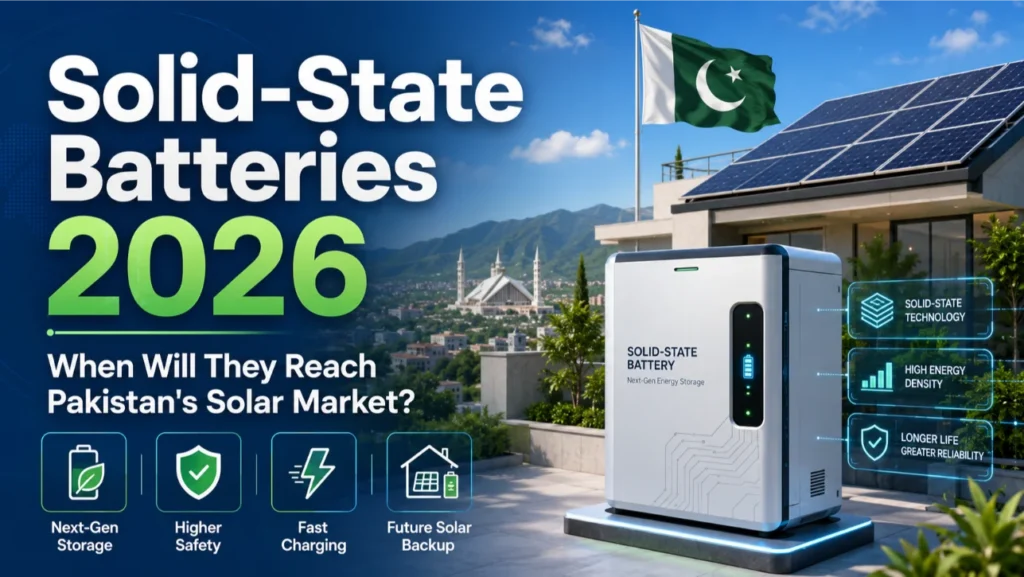
Solid-State Batteries 2026 — When Will They Reach Pakistan’s Solar Market?
What Are Solid-State Batteries?
Today’s lithium batteries (including LiFePO4 used in home solar storage) use a liquid electrolyte to carry ions between the anode and cathode during charging and discharging. Solid-state batteries replace this liquid with a solid electrolyte — ceramic, glass, or polymer-based material.
The liquid electrolyte in conventional batteries is flammable, degrades over time, and limits operating temperature. A solid electrolyte eliminates these problems, enabling batteries that are safer, more energy-dense, and longer-lasting.
Solid-State vs Current LiFePO4 Batteries
| Factor | Current LiFePO4 (e.g., Pylontech) | Solid-State (projected) |
|---|---|---|
| Energy Density | ~120–160 Wh/kg | 300–500 Wh/kg (projected) |
| Cycle Life | 6,000–8,000 cycles | 10,000+ cycles (projected) |
| Safety | Very safe (LiFePO4) | Even safer (no liquid electrolyte) |
| Temperature Range | -10°C to 50°C | -30°C to 100°C (projected) |
| Cost (current) | Rs. 40–60 per Wh | 3–5× higher currently |
| Commercial availability | Widely available now | EV-scale only, limited |
| Expected Pakistan availability | Now | 2030–2035 at earliest |
Where Solid-State Stands in 2026
Toyota, Samsung SDI, QuantumScape, Solid Power, and CATL are all investing billions in solid-state battery development. In 2026, solid-state batteries have appeared in limited commercial EV applications (Toyota’s first solid-state EV models), but they remain extremely expensive and small-scale.
For home solar storage applications — which require large capacity (5–20 kWh per unit), low cost, and proven long-term reliability — solid-state is still years away from being practical.
What This Means for Pakistan’s Solar Market
- 2026–2028: Solid-state batteries exist only in high-cost EV and specialty applications — not in home solar storage at any price
- 2029–2032: First solid-state home storage products may appear at extreme premium prices in developed markets (Europe, US, Japan)
- 2033–2038: Possible mass-market pricing if manufacturing scales — Pakistan market entry possible in this window
- Current LiFePO4 remains the right choice: Pylontech, Dyness, BYD batteries with 6,000–8,000 cycle life and 10-year warranties deliver excellent performance at prices that make solar systems economically viable now
Frequently Asked Questions
🔋 Today’s best solar batteries — available now in Pakistan
Sources & references
Tariff, net-metering, and policy details on this page draw on the following official sources. Rates change often, so confirm current figures with the relevant authority or a licensed installer before you decide.
- NEPRA — National Electric Power Regulatory Authority: electricity tariffs and the 2026 shift from net metering to net billing.
- AEDB — Alternative Energy Development Board: solar policy, installer standards, and net-metering guidance.
- Your local distribution company (DISCO) — for example LESCO, K-Electric, IESCO, MEPCO, PESCO or QESCO — for area-specific tariffs and the net-metering application process.